Tuesday, August 24, 2021

Tuesday Tidbits: TAKE A SPIN ON THE WILD SIDE

Montgomery County Jail Building

In 1881, architect William H. Brown answered the human incarceration problem with an engineering solution by designed a revolutionary new jail concept in housing criminals. Brown teamed up with Benjamin F. Haugh. Haugh, Ketcham & Co. iron foundry in Indianapolis, Indiana build this modern masterpiece.

What was this work of genius, you may ask? A rotary jail.

Hmm… Sounds a bit odd. But whenever someone comes up with a new solution or new take on an old problem, it can seem odd. Let’s find out how this one stacks up on the oddity chart.

Brown’s idea was to have a revolving cell block. There were generally eight wedge-shaped cells per floor with a single exit shared by all the cells on that floor. This way only one cell could be accessed at a time, providing more security and fewer guards required to oversee the prisoners.

Cell Platform

The patent for this new style of jail had this description:
“The object of our inventions is to produce a jail in which prisoners can be controlled without the necessity of personal contact between them and the jailer or guard ... it consists, first, of a circular cell structure of considerable size (inside the usual prison building) divided into several cells capable of being rotated, surrounded by a grating in close proximity thereto, which has only such number of openings (usually one) as is necessary for the convenient handling of prisoners.”


Cell Door Partially Open & Cell Door Open

Sounds like the perfect social-distancing facility between guards and inmates. But one cell would often house more than one prisoner. No social distancing there.


The greased mechanism was so well-built and the unit sat on a ball-bering surface that a single man could work the crank to spin the entire block.

Gear for Moving Platform


This video shows a man cranking the handle to rotate the cell block.

 https://www.youtube.com/watch?v=MIswvJFoT0A


Rotating Crank Mechanism

In the late 1800s, several of these rotary jails were built across the American Midwest. The first was constructed in Crawfordsville, Indiana in 1882. Five others were soon built in the Midwest. In total, eighteen of these bad boys were erected at a cost of $30,000 each.

Rotary Jail in Gallatin, Missouri


The rotary jail boasted an indoor, sanitary plumbing system, a luxury most regular people didn’t have yet. Prisoners received three meals a day, a hot bath, and their clothes laundered. A pretty sweet deal.


Detail Diagram of Central Core Plumbing Connections to Cell.


Very quickly the pitfalls and safety hazards to this style of construction became evident. First, the jails often held mostly individuals too inebriated to walk. They might pass out in their cell with an arm or leg through the bars. Then when the cell block was rotated, arms and legs were injured ... or worse.

Another hazard was what to do in case of a fire. A guard would need to stay behind to turn the crank handle to let the prisoners out one wedge-shaped cell at a time. Who was going to watch these freed prisoners with the reduced manpower? And what if the guard was too afraid for his own life to stay inside a burning building. Not good. A set up for failure.

Double-Tiered Cell Block

Due to the safety hazards, most of the rotary jails had their mechanisms welded into a stationary position and doors made for each cell within a few years. Nearly all of these jails were decommissioned by 1939. The Pottawattamie County jail in Council Bluffs, Iowa was the last of these jails in service. It shut down in December of 1969. It’s rotating mechanism was still in use up to 1960.


Food Pass-Through Slot

The Montgomery County rotary jail in Crawfordsville, Indiana is the only one of these jails still able to rotate. However, no prisoners are housed there as it is now a museum. This would be so much fun to visit.

I would give Brown high marks for ingenuity, creativity, and out of the box thinking. But very-low marks for safety considerations before construction and cost savings for their clients. I wonder if any of the towns, which had these jails built, recouped the money they were supposed to save with paying fewer guards.


NEW RELEASE!!! 

THE DÉBUTANTE'S SECRET (Quilting Circle 4)

Will Geneviève open her heart to a love she never imagined?

Washington State 1894

Geneviève Marseille has one purpose in coming to Kamola—stopping her brother from digging up the past. Deputy Montana has lived a simple life. But when a fancy French lady steps off the train and into his arms, his modest existence might not be enough anymore. A nemesis from Aunt Henny's past arrives in town threatening her with jail. Will she flee as she’d done all those years ago, or stand her ground in the town she’s made her home? When secrets come out, will the lives of Geneviève, Montana, and Aunt Henny ever be the same?


MARY DAVIS is a bestselling, award-winning novelist of over two dozen titles in both historical and contemporary themes. Her latest release is THE DAMSEL’S INTENT (The Quilting Circle Book 3, Salah Award Winner). The Quilting Circle Book 4, THE DÉBUTANTE'S SECRET, will release August of 2021. Some of her other recent titles include; "Holly and Ivy" in A Bouquet of Brides CollectionCourting Her Amish HeartThe Widow’s PlightCourting Her Secret Heart , “Zola’s Cross-Country Adventure” in The MISSAdventure Brides Collection , and Courting Her Prodigal Heart . 2019 titles include The Daughter's Predicament and "Bygones" in Thimbles and Threads. She is a member of ACFW and active in critique groups.
Mary lives in the Pacific Northwest with her husband of thirty-seven years and one cat. She has three adult children and three incredibly adorable grandchildren. Find her online at:

Tuesday, August 17, 2021

Tuesday Tidbits: THIS OR THAT?

Randolph Caldecott (1846-1886),
Public domain, via Wikimedia Commons

A few weeks ago as I headed out to the car, there was a big ol’ black bird. Was it a crow or a raven? Were they one and the same just different names? Like couch and sofa. Or soda and pop.

So, I asked my hubby, “What’s the difference between a crow and a raven?”

He came back with a quick, snappy answer. “The spelling.”

Cracked me up.

My brain kept turning my question around in my head until I had to look it up.

They are two different birds. The similarities are that they are birds, black, and intelligent.
They are both part of the genus Corvus. The main differences seem to be the size and voice. A crow is smaller, being about the size of a dove, has a mid-range caw-caw. A raven is closer to the size of a hawk and has a course rattling call like a long, slow croaking tone. There are many other minor differences like tail shape, habitat, feather sheen, and lifespan, eight years for crows and thirty for ravens.


In my defense of not knowing the differences before, “crow” is a broad synonym for all of the genus Corvus. So, I could call a raven a crow but not a crow a raven.

Here is a video on many of the differences between a crow and a raven. 


https://www.youtube.com/watch?v=eZ5iippq3rA

So, that begged the question about other similar animals. Is a rabbit a hare and a hare a rabbit? As I suspected, they are two different animals but of the same genus Leporidae. Rabbits are all-around smaller, smaller body, smaller ears, smaller hind legs. There are some large breed rabbits, but generally they are smaller than hares. Hares are faster, live above ground. Their babies are born furry, with their eyes open and need little adult care. Rabbits are slower, burrow underground, and their babies are born naked with closed eyes and need to be taken care of.


Next, I went on a search of mushrooms and toadstools. These two terms are not scientific ones for these fungi. It seems the general rule is mushrooms are edible and toadstools aren’t. However, there aren’t clear-cut, visible physical characteristics that set them apart. One would need a microscope and scalpel to look at the molecular makeup of a fungi to tell if it was an edible mushroom or a poisonous toadstool.

I think that’s enough of This or That.

(This is in no way a scientific study of these comparisons, but my conclusions for my own peace of mind on these pairs.)


NEW RELEASE!!! THE DÉBUTANTE'S SECRET (Quilting Circle 4)

Will Geneviève open her heart to a love she never imagined?

Washington State 1894

Geneviève Marseille has one purpose in coming to Kamola—stopping her brother from digging up the past. Deputy Montana has lived a simple life. But when a fancy French lady steps off the train and into his arms, his modest existence might not be enough anymore. A nemesis from Aunt Henny's past arrives in town threatening her with jail. Will she flee as she’d done all those years ago, or stand her ground in the town she’s made her home? When secrets come out, will the lives of Geneviève, Montana, and Aunt Henny ever be the same?


MARY DAVIS is a bestselling, award-winning novelist of over two dozen titles in both historical and contemporary themes. Her latest release is THE DAMSEL’S INTENT (The Quilting Circle Book 3, Salah Award Winner). The Quilting Circle Book 4, THE DÉBUTANTE'S SECRET, will release August of 2021. Some of her other recent titles include; "Holly and Ivy" in A Bouquet of Brides CollectionCourting Her Amish HeartThe Widow’s PlightCourting Her Secret Heart , “Zola’s Cross-Country Adventure” in The MISSAdventure Brides Collection , and Courting Her Prodigal Heart . 2019 titles include The Daughter's Predicament and "Bygones" in Thimbles and Threads. She is a member of ACFW and active in critique groups.
Mary lives in the Pacific Northwest with her husband of thirty-seven years and one cat. She has three adult children and three incredibly adorable grandchildren. Find her online at:

Tuesday, August 3, 2021

Tuesday Tidbits: THE HANDSOME HANSOM


In York, England, architect Joseph A. Hansom designed the Hansom Safety Cab and patented it in 1834. The cab he created was a light, fast two-wheeled vehicle pulled by a single horse and designed to ferry one or two passengers—three if they squished together. It was also known as the two-wheeled “safety cab” because the low center of gravity made it less likely to tip over on tight turns anti was maneuverable through city traffic.

The hansom cab replaced the larger four-wheeled hackney for hired transportation for one or two people. It also afforded a better view than a side window of a larger carriage as the front was open. John Chapman modified the design, as well as others, to make it more practical but kept the Hansom name. 

A typical charge could be 30 cents for one person (40 cents for two) up to a mile and 75 cents for one or two people for up to an hour. Though most of the Hansom Cabs were for hire, many were also in the private service of some wealthy individuals.

The driver sat on a sprung seat at the back of the vehicle. A trapdoor in the rear of the roof allowed passengers to communicate a destination to the driver as well as pass the fare money through the hatch to him. Once paid, the driver would operate a level to release the doors so the passengers could exit.

Low, folding wooden doors could enclose the passengers’ feet and legs to protect them from weather and splashing mud. The curved front fender protected against rocks being kicked up by horse’s hooves. Later models included an up-and-over glass window above the doors to complete the enclosure.

I have wondered from time to time where the term taxicab came from. Cab was short for cabriolet, the style of carriage used for hire. Taxi is short for taximeter, the devices created to measure the distance traveled. Put them together, and you get taxicab.

In The Débutante’s Secret, that releases in a few days, Geneviève Marseille seeks out a Hansom Cab to hire, but they haven’t made their way to the college town. However, Kamola is well on its way to having an organized cab service with the handful of industrious fellows who linger with their buggies near places (the college and hotels) they are likely to find fares at.


***NOW AVAILABLE FOR PRE-ORDER***

THE DÉBUTANTE'S SECRET (Quilting Circle 4)

Will Geneviève open her heart to a love she never imagined?

Washington State 1894

Geneviève Marseille has one purpose in coming to Kamola—stopping her brother from digging up the past. Deputy Montana has lived a simple life. But when a fancy French lady steps off the train and into his arms, his modest existence might not be enough anymore. A nemesis from Aunt Henny's past arrives in town threatening her with jail. Will she flee as she’d done all those years ago, or stand her ground in the town she’s made her home? When secrets come out, will the lives of Geneviève, Montana, and Aunt Henny ever be the same?


MARY DAVIS is a bestselling, award-winning novelist of over two dozen titles in both historical and contemporary themes. Her latest release is THE DAMSEL’S INTENT (The Quilting Circle Book 3, Salah Award Winner). The Quilting Circle Book 4, THE DÉBUTANTE'S SECRET, will release August of 2021. Some of her other recent titles include; "Holly and Ivy" in A Bouquet of Brides CollectionCourting Her Amish HeartThe Widow’s PlightCourting Her Secret Heart , “Zola’s Cross-Country Adventure” in The MISSAdventure Brides Collection , and Courting Her Prodigal Heart . 2019 titles include The Daughter's Predicament and "Bygones" in Thimbles and Threads. She is a member of ACFW and active in critique groups.
Mary lives in the Pacific Northwest with her husband of thirty-seven years and one cat. She has three adult children and three incredibly adorable grandchildren. Find her online at:


Tuesday, July 27, 2021

Tuesday Tidbits: A PUFF OF FASHION HISTORY

One of my favorite scenes in the Anne of Green Gables miniseries produced in the 1980s was when Matthew (Anne’s male guardian) bought her a dress with puffed sleeves. Matthew comments on the puffed sleeves, and Anne says, “The puffiest in the world.” Oh, yeah. That’s what I’m talking about.

Puffed, gigot, and leg o’ mutton sleeves were all very voluminous and popular in the 1890s. The term “leg o’ mutton” comes from shape of a leg of lamb, bulbous at one end and narrow at the other like a turkey drumstick. Even though the shapes are very similar, I still find it peculiar to name a sleeve after an animal part that is used for food. But no one asked me when naming the gloriously poofy sleeves.


Sleeves are often a key fashion element of a garment that creates the overall silhouette. Puffed sleeves have come and gone from fashion over the decades and centuries. Puffy sleeves can be seen in the 1830s, 1850s, 1890s, 1930s, 1980s, and apparently, as of Spring and Summer 2021, puffed sleeves are back once again.

I often wondered how they managed to keep historical puffed sleeves puffy. The trick was the “sleeve puffs” or “plumpers.” These were pillow-like things stuffed with down or feathers that were slipped around the arm and tied in place on the corset to keep them from slipping down. Light weight, yet poofy. Perfect.

In my novel The Débutante’s Secret that releases in August, I gave my heroine my love of puffed sleeves. My story takes place in the 1890s. The decade started out with relatively slim sleeves and bloomed from there, getting puffier and puffier. Some were so big, they bordered on absurd.

My down-to-earth hero (a deputy) in The Débutante’s Secret doesn’t understand the heroine’s sleeve choice, but he’s impressed by how she manages to effortlessly maneuver her massive sleeves through a doorway without them even touching the door frame. I, too, had wondered how it could done, so I put myself in my heroine’s sleeves and proceeded to mentally walk through a doorway. Since she usually wore this style of sleeves, she wouldn’t have any trouble navigating through a doorway.

I’m secretly pleased that puffy sleeves are back. Shhhhh. Don’t tell anyone.

Do you like puffed sleeves?


***NOW AVAILABLE FOR PRE-ORDER***

THE DÉBUTANTE'S SECRET (Quilting Circle 4)

Will Geneviève open her heart to a love she never imagined?

Washington State 1894

Geneviève Marseille has one purpose in coming to Kamola—stopping her brother from digging up the past. Deputy Montana has lived a simple life. But when a fancy French lady steps off the train and into his arms, his modest existence might not be enough anymore. A nemesis from Aunt Henny's past arrives in town threatening her with jail. Will she flee as she’d done all those years ago, or stand her ground in the town she’s made her home? When secrets come out, will the lives of Geneviève, Montana, and Aunt Henny ever be the same?


MARY DAVIS is a bestselling, award-winning novelist of over two dozen titles in both historical and contemporary themes. Her latest release is THE DAMSEL’S INTENT (The Quilting Circle Book 3, Salah Award Winner). The Quilting Circle Book 4, THE DÉBUTANTE'S SECRET, will release August of 2021. Some of her other recent titles include; "Holly and Ivy" in A Bouquet of Brides CollectionCourting Her Amish HeartThe Widow’s PlightCourting Her Secret Heart , “Zola’s Cross-Country Adventure” in The MISSAdventure Brides Collection , and Courting Her Prodigal Heart . 2019 titles include The Daughter's Predicament and "Bygones" in Thimbles and Threads. She is a member of ACFW and active in critique groups.
Mary lives in the Pacific Northwest with her husband of thirty-seven years and one cat. She has three adult children and three incredibly adorable grandchildren. Find her online at:

Tuesday, July 20, 2021

Tuesday Tidbits: THE MAKING OF A COLLEGE COW TOWN


   Before there was a town, the Kittitas Valley, where Ellensburg is located, was important to the native tribes who gathered in the area to harvest camas roots and sweet onions, to graze and race their horses, settle disputes, forge family ties, feast, and play games.
   In July 1848, Father Pandosy established the first non-native home in the Ellensburg area. It was a small structure to house a mission called Immaculate Conception on Manastash Creek. He hoped to bring Christianity to the natives. He served there until September of 1849.
   The Kittitas Valley was the scene of many cattle drives that went through the area, either heading north into Canada or over the Cascade Mountains toward Seattle.
   William Wilson came in 1867 and built a cabin on a creek which would bear his name, Wilson Creek. Wilson passed away due a disagreement over another man’s horse.


   Andrew Jackson Splawn, cowboy and future state senator, and Ben Burch, in 1870, hired Martin Davern to haul Wilson’s cabin to what is now the middle of Ellensburg to be the first store in the Kittitas Valley. That seems like a difficult task. I don’t know why they didn’t simply built a new structure. The tiny business was christened “Robber’s Roost”. Hmm? Would I trust a business with “robber” in its name?


   In 1871 John and Mary Ellen Shoudy left Seattle for the Kittitas Valley. Shoudy and his brother-in-law Dexter Horton, a banker, were among a group of Seattleites who wished to establish a wagon route through the Cascade Mountains. After the streets were platted in 1875, Shoudy named this budding new town Ellensburgh after his wife, Mary Ellen. You might not have noticed the final “h” on the town’s name. Apparently, the United States Post Office deemed it unnecessary and dropped it in 1894.


   In 1878, this young town could boast its first permanent physician, Dr. Middleton Amen. The first saloon came on the scene at that time as well. Close on the heels of medicine and booze, during the winter of 1881-1882, the first session of public school was held with William O. Ames as teacher.


   Ellensburg was becoming quite civilized and soon became the hub of traffic west, north, east, and south. It had location in its favor. The town’s growth accelerated in 1883 with the First National Bank of Ellensburg, the Ellensburg Hook and Ladder Company No 1, and being named the county seat for the newly established Kittitas County. Northern Pacific Railroad completed a depot in 1886.


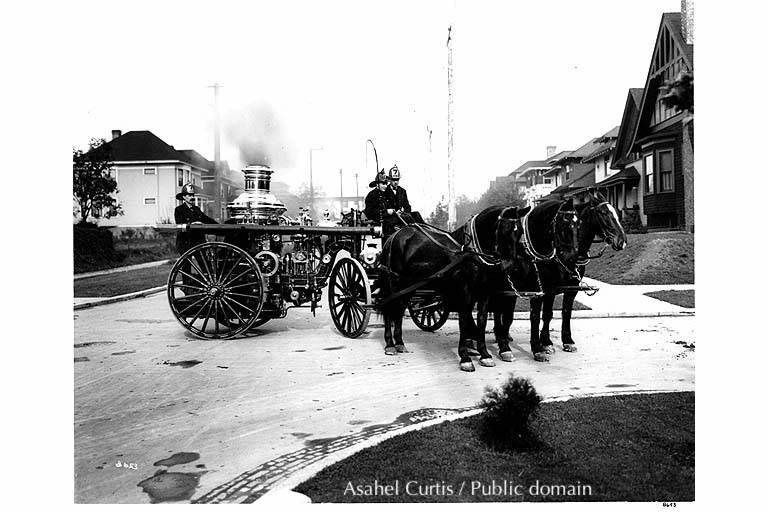
   A fire engine such as this was no match for the blaze that swept through Ellensburg in 1889. Like with many town and cities destroyed by fire, it was decided to have brick buildings replace the destroyed ones.


   Ellensburg had been in the running to the state’s capital, but in the November 4, 1890 election, Olympia was chosen. That same year, the first telephone service arrived.


   The following year, the Washington State Normal School opened in a temporary borrowed building and moved to their own building in 1894. The name was changed to Central Washington College of Education in 1937, Central Washington State College in 1961, and finally Central Washington University in 1977.


   You might be wondering why I chose to give the history of this modest town in the middle of Washington State. I attended college there and love the town. So I loosely based my town, Kamola, in The QUILTING CIRCLE series on Ellensburg and named it after the dorm, Kamola, I lived in. I have not used all of these elements in my fictional town, but they might show up in future books.


***NOW AVAILABLE FOR PRE-ORDER***

THE DÉBUTANTE'S SECRET (Quilting Circle 4)

Will Geneviève open her heart to a love she never imagined?

Washington State 1894

Geneviève Marseille has one purpose in coming to Kamola—stopping her brother from digging up the past. Deputy Montana has lived a simple life. But when a fancy French lady steps off the train and into his arms, his modest existence might not be enough anymore. A nemesis from Aunt Henny's past arrives in town threatening her with jail. Will she flee as she’d done all those years ago, or stand her ground in the town she’s made her home? When secrets come out, will the lives of Geneviève, Montana, and Aunt Henny ever be the same?


MARY DAVIS is a bestselling, award-winning novelist of over two dozen titles in both historical and contemporary themes. Her latest release is THE DAMSEL’S INTENT (The Quilting Circle Book 3, Salah Award Winner). The Quilting Circle Book 4, THE DÉBUTANTE'S SECRET, will release August of 2021. Some of her other recent titles include; "Holly and Ivy" in A Bouquet of Brides CollectionCourting Her Amish HeartThe Widow’s PlightCourting Her Secret Heart , “Zola’s Cross-Country Adventure” in The MISSAdventure Brides Collection , and Courting Her Prodigal Heart . 2019 titles include The Daughter's Predicament and "Bygones" in Thimbles and Threads. She is a member of ACFW and active in critique groups.
Mary lives in the Pacific Northwest with her husband of thirty-seven years and one cat. She has three adult children and three incredibly adorable grandchildren. Find her online at:


Tuesday Tidbits: BUSY, BUSY, BUSY

       I’ve been buzzing around, flitting from one thing to another just like this bumblebee.     The weeds, as usual, are overr...